Minimally invasive surgery in Vienna
Many gynaecological operations can now be carried out without a large abdominal incision. Through a few small incisions, or through the vagina with no external incision at all, it is possible, for example, to remove ovarian cysts, treat areas of endometriosis and remove fibroids while leaving the uterus in place. These techniques are known as minimally invasive or endoscopic surgery. As a specialist in gynaecology and obstetrics, I have had minimally invasive surgery as one of my areas of focus for many years. I have worked particularly intensively on cysts, endometriosis and fibroids. In 2003 I founded the ZEM outpatient clinic at AKH Wien and headed it until the end of 2023. On this page I explain which techniques are available, what happens during an operation and what you can expect afterwards.
Which minimally invasive techniques are there?
Laparoscopy (keyhole surgery)
In a laparoscopy, often called keyhole surgery, a camera is inserted into the abdominal cavity through a small incision, usually in the area of the navel. Further small incisions are used for the surgical instruments. The abdominal cavity is filled with carbon dioxide so that the uterus, ovaries, fallopian tubes and peritoneum (the lining of the abdomen) can be seen clearly.
The procedures that can be carried out by laparoscopy include:
Sterilisation can also be carried out laparoscopically if you are certain that your family is complete.
Hysteroscopy
Hysteroscopy, an examination of the inside of the uterus (womb) with a camera, requires no external incision. A thin telescope is passed through the vagina and cervix into the uterine cavity. This allows me to assess the lining of the uterus directly and to treat, for example, polyps, fibroids that protrude into the uterine cavity, or adhesions. Certain malformations of the uterine cavity can also be investigated by hysteroscopy and in some cases treated. Hysteroscopy is also used to investigate certain bleeding disorders and for selected questions in connection with difficulty conceiving. Both techniques are forms of endoscopy. For questions involving the bladder or ureters, I work with colleagues in urology where necessary.
What advantages does laparoscopy have over open abdominal surgery?
The most visible difference is the smaller scars. A laparoscopy usually leaves only a few small skin incisions. Compared with an open operation, minimally invasive surgery often offers further advantages for suitable procedures:
The camera also provides a magnified view of the organs and of fine anatomical structures. With endometriosis in particular, this precise view can be helpful for surgical treatment. Not every operation is suitable for a minimally invasive technique. With very large findings, extensive adhesions, certain previous operations or a suspected malignant disease, an open procedure may be more appropriate or safer. Even once a laparoscopy has begun, it can in rare cases become necessary to switch to an open abdominal incision.
Why is preserving the uterus an important aim?
When I founded the ZEM outpatient clinic in 2003, uterus-preserving treatment of cysts, endometriosis and fibroids was a central focus. Today, many fibroids can be removed, areas of endometriosis treated and ovarian cysts operated on without having to remove the uterus. This is crucial particularly if you wish to have children. Even once their family is complete, many patients want to keep their uterus, and this wish is taken into account when planning treatment.
If removal of the uterus is nevertheless medically advisable, for instance in the case of severe symptoms and no suitable alternatives, this procedure too can often be carried out by a minimally invasive technique. The ovaries are not automatically removed at the same time. Whether they can and should be preserved is assessed individually.
What happens when you have an operation with me?
Everything begins with a detailed conversation at my practice. We discuss your symptoms, your medical history and your personal wishes, in particular any wish to have children. I then examine you and, as a rule, carry out an ultrasound scan. With certain findings, additional investigations such as magnetic resonance imaging (MRI) or laboratory tests are useful. Only after that do I discuss with you whether an operation is necessary or whether monitoring or drug treatment is the better option.
Preparing for the operation
If we decide together on a procedure, I explain to you:
You also receive the necessary written information and, for a private operation, a cost estimate, so that you can clarify cover with your supplementary private insurance.
Before the procedure, the anaesthetic assessment takes place. Which tests are needed for this depends, among other things, on your age, any existing conditions and the type of operation.
A laparoscopy is carried out under general anaesthesia. For a hysteroscopy, the type of anaesthesia depends on the extent of the procedure. Smaller diagnostic hysteroscopies can also be carried out without general anaesthesia or with local anaesthesia, while operative procedures are often carried out under anaesthesia.
After the operation
After a smaller hysteroscopy you can often go home the same day. Some laparoscopies can also be done as day surgery. After more extensive procedures, a hospital stay of one or more nights may be necessary. When the first follow-up is advisable depends on the procedure. If tissue has been removed, I also discuss the histology report with you. Further follow-ups depend on the type of operation, how your recovery is progressing and your symptoms.
Where do I operate?
Since leaving the University Department of Obstetrics and Gynaecology at the end of 2023, I no longer carry out operations as part of my former work at AKH Wien. Depending on the type of operation and individual arrangement, private surgical procedures can take place at Privatklinik Confraternität & Goldenes Kreuz or at Privatklinik Döbling, among others. Which hospital and which organisational arrangements are suitable for your procedure is something we clarify in a personal conversation.
What are the risks of a minimally invasive operation?
Every operation carries risks, and I consider it important to name them clearly. During a laparoscopy, the bowel, bladder, ureters or blood vessels can be injured in rare cases. The risk depends, among other things, on the type of procedure, previous operations and any adhesions. As with any operation, bleeding, infection, thrombosis or complications of the anaesthetic can also occur. In rare cases it can become necessary to switch to an open abdominal incision during the operation.
After a laparoscopy, shoulder pain or upper abdominal pain sometimes occurs for a few hours or days. The cause is usually the carbon dioxide used for the operation.
During a hysteroscopy there can, rarely, be an injury to the wall of the uterus, bleeding, infection or problems caused by the fluid used to distend the uterine cavity. After the removal of fibroids or adhesions, adhesions can form again, which can be relevant particularly if you wish to have children.
Even extensive experience cannot rule out surgical risks completely. I have been working in gynaecological surgery for more than 30 years and, over many years at the University Department of Obstetrics and Gynaecology, I practised and taught minimally invasive surgery and contributed to research on it.
How long does recovery take?
The recovery time depends largely on the type and extent of the procedure. After a smaller hysteroscopy, many patients can return to their usual activities as early as the following day. Light bleeding or lower abdominal discomfort for a few days is possible.
After a laparoscopy, recovery from smaller procedures usually takes a few days. After more extensive operations, such as the removal of fibroids or extensive endometriosis surgery, it can take several weeks before you are fully fit again. When you can work, exercise, lift heavy objects, take a bath or have sexual intercourse again depends on the specific procedure and how your recovery is progressing. For this reason, after the operation you receive precise recommendations for the first days and weeks.
Why Prof. Obwegeser?
I worked at the University Department of Obstetrics and Gynaecology at Vienna General Hospital (AKH Wien) from 1989 until the end of 2023, from 1994 as senior consultant. Over decades there I gained experience in gynaecological surgery and in the treatment of complex gynaecological findings.
In 2003 I founded the ZEM outpatient clinic for cysts, endometriosis and fibroids and headed it until the end of 2023. One focus was the minimally invasive treatment of these conditions, preserving the organs wherever possible. A research group also grew up around the clinic.
Minimally invasive surgery has been one of my clinical and research interests for many years. At the same time, it is important to me to recommend an operation only when it offers a meaningful advantage over monitoring or drug treatment. At my practice I take the time to explain to you, in terms you can follow, the finding, the various treatment options and what a planned procedure involves.
What does an operation cost?
The costs depend on the type and extent of the procedure, the hospital chosen and the length of stay. Before an operation carried out privately you receive a written cost estimate that sets out the expected costs transparently. With this you can, if necessary, obtain confirmation of cover from your supplementary private insurance.
For consultations and examinations at my private practice you receive an invoice, which you can submit to your health insurer for reimbursement. The amount reimbursed depends on the insurer and the services provided.
We will be happy to tell you the specific amount for your concern in advance by telephone.
Does a laparoscopy leave scars?
Yes. It usually leaves several small scars, often one of them in the area of the navel. As a rule they become much less noticeable over time. The size and number of the skin incisions depend on the procedure concerned.
Can I still get pregnant after a laparoscopy?
In many cases, yes. What matters, however, is not the laparoscopy itself but which condition was treated and which procedure was carried out. If you wish to have children, I plan an operation so as to spare the organs and fertility as far as possible. When a pregnancy is advisable after the procedure depends on the specific operation. After the removal of a fibroid from the wall of the uterus, for example, a healing period can be advisable. There is, however, no generally applicable waiting time of three to six months.
Do I have to have a general anaesthetic for the operation?
A laparoscopy is, as a rule, carried out under general anaesthesia. For a hysteroscopy, the type of anaesthesia depends on the extent of the procedure. Diagnostic or smaller hysteroscopic procedures can in some cases be carried out without general anaesthesia, while operative procedures are often carried out under anaesthesia. We discuss before the procedure which form is appropriate in your case.
How long will I be on sick leave after the operation?
That depends on the procedure and on the work you do. After a smaller hysteroscopy, many patients are fit for work again after a short time. After a laparoscopy, recovery can take from a few days to several weeks. After larger procedures, or if your work is physically demanding, a longer period of rest is often necessary.
Will you operate on me personally?
Yes. If we plan an operation together, I discuss the procedure with you beforehand and carry out the agreed operation personally. The follow-ups can then also take place at my practice.
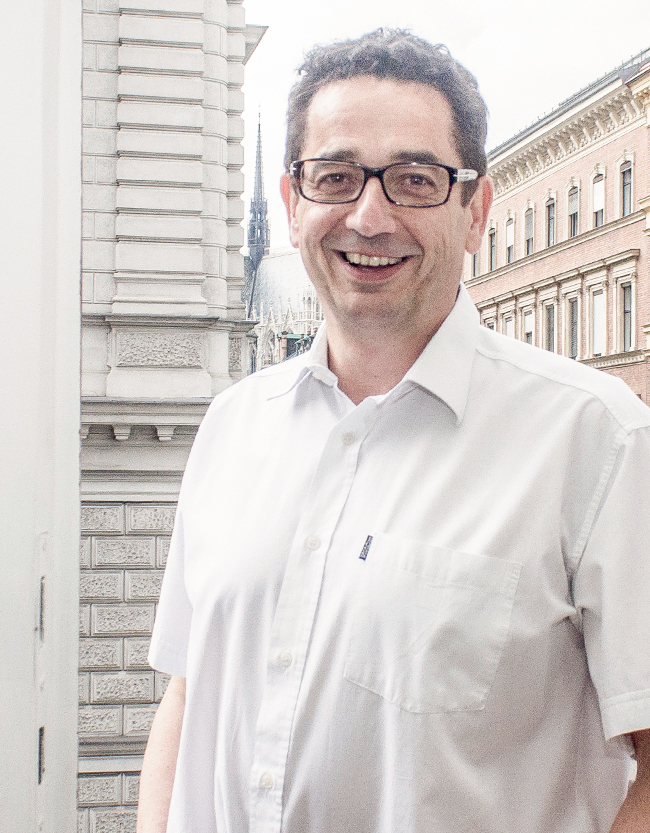
From 1989 to 2023 at the University Department of Obstetrics and Gynaecology at Vienna General Hospital (AKH Wien), senior consultant from 1994; founder and long-standing head of the ZEM outpatient clinic for cysts, endometriosis and fibroids.
If you would like to know whether your finding can be treated by a minimally invasive technique, call us on +43 1 317 660 0 or write to ordination@prof-obwegeser.at. I give appointments by prior arrangement by telephone. My practice is at Hörlgasse 14, Top 11, 1090 Wien. The entrance is at Liechtensteinstraße 8.